
You are playing Scrabble. Or maybe, because we live in the future, you are playing Words With Friends on a supercomputer that fits in your palm. You have the following tiles: CMOHVER. A quick glance sees that you can play COVER for 10 points. Oh wait, you can also play MOVER (10 points) or even HOVER (11 points). Assuming there are no delightful puns or perhaps a clever response to the word your opponent just played, all three of these plays are basically the same. So which should you play? Does it even make a difference? And if it does make a difference, could a graph possibly help you here?
Of course a graph can help you. First, use the internet to find a downloadable text file of the Scrabble dictionary. I went with TWL06, which I found here. Then, find a friend who knows more about Excel than you do, such as Matt. Have him count the number of times each letter appears in said word list. Plot that data against the number of letter tiles in Scrabble. A trend line might be helpful too. With a little effort, make something that looks like this:
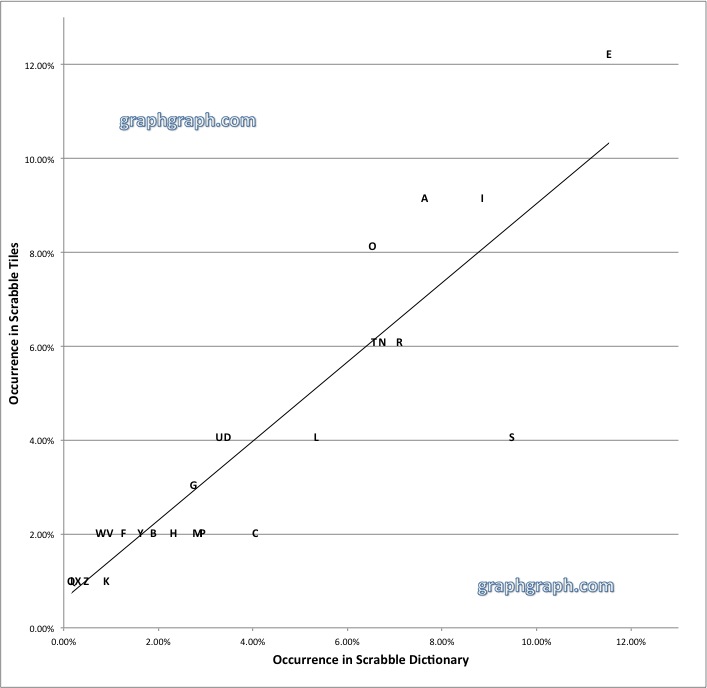
A few things jump out. E is by far the most common letter AND the most common tile. Not very surprising. More curiously, S is the second most common letter but is significantly under-represented in the bag of tiles. Presumably this is to avoid the excessively easy and opportunistic play of creating plurals all the time. I is more common than A in the scrabble dictionary (contrary to frequency in the english language) and both are more well represented in the bag and in the dictionary than T, which is by most accounts the second most common letter in english.
Back to our original conundrum: Which word should be played? The trend line in our graph serves as a useful border. Letters on the northwest side occur more commonly in the bag than in the dictionary, letters on the southeast side the opposite. Therefore, use the letters farthest northwest when all other gameplay elements are equal, as they appear in fewer words and are more likely to be drawn again later. To phrase it differently, you are conserving tiles with a higher frequency-utility ratio. In the case of our example above, play HOVER, as the C and the M are more likely to be useful later in the game.
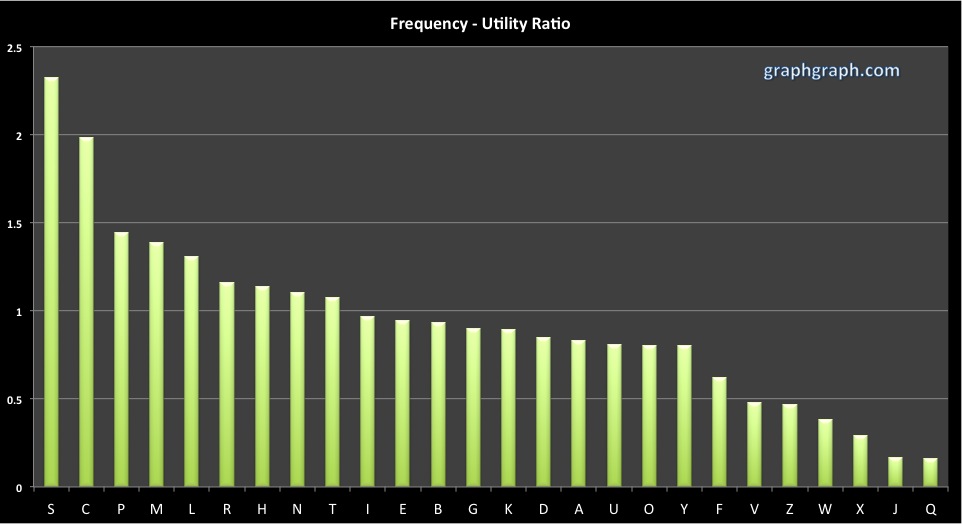
Naturally, however, you eschewed COVER, HOVER, and MOVER and instead played CHROME for 13 points. Good for you.
Where’s the follow up graph of letter pairings? C may appear a lot, but might be much less useful without an H. Mover might be the smart play here as CH words might make up a predominant number of C words.
😛
I’m just nitpicking. Cool graph and great idea. 😛
Well written article. Humourous and insightful. Could be good concept to consider for ‘balancing the rack’.