
Sometimes at work we get requests to visualize data on maps. It’s a really cool feature, but the challenge is generally the calculation being used to drive the chart is a straight sum, and states like California, New York, and Texas always seem to have the highest values.
XKCD had a great comic the other day that I 100% agree with: the problem with geographic heat maps is that it’s essentially just a population map.
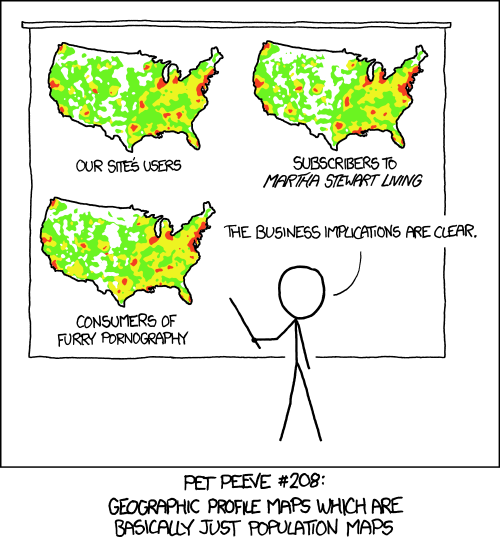
[xkcd]
This is why anytime you’re putting together a heat map, it’s best to normalize the data as best as you can with a per-capita calculation.
Compare the following two calculations:
- Summation -> Sum(Measure)
- Per Capita -> Sum(Measure)/Sum(Number of People in that Grouping)
This very simple switch allows you to make a much more effective comparison of large states like California to small states like Rhode Island.
USA Today offers a graph every morning in the bottom-left corner of the front page.
Take a look at this first one:

Why am I not surprised by these results? It’s essentially a “top 5 population” map. The only thing that seems off is that Arizona and Georgia are showing up here, but I’m bringing outside knowledge that the population is not very high there, so I can assume that it must be an outlier.
However a few weeks later I picked up the paper and pleasantly surprised to see this map:

Much better! Now that they’ve switched to a percentage-focused view, I get a much better sense that in these states the proportions are indeed larger when compared to other states.
Map visualizations can be very powerful, but a little simple division can help you get a greater wealth of information from the same pixel space!